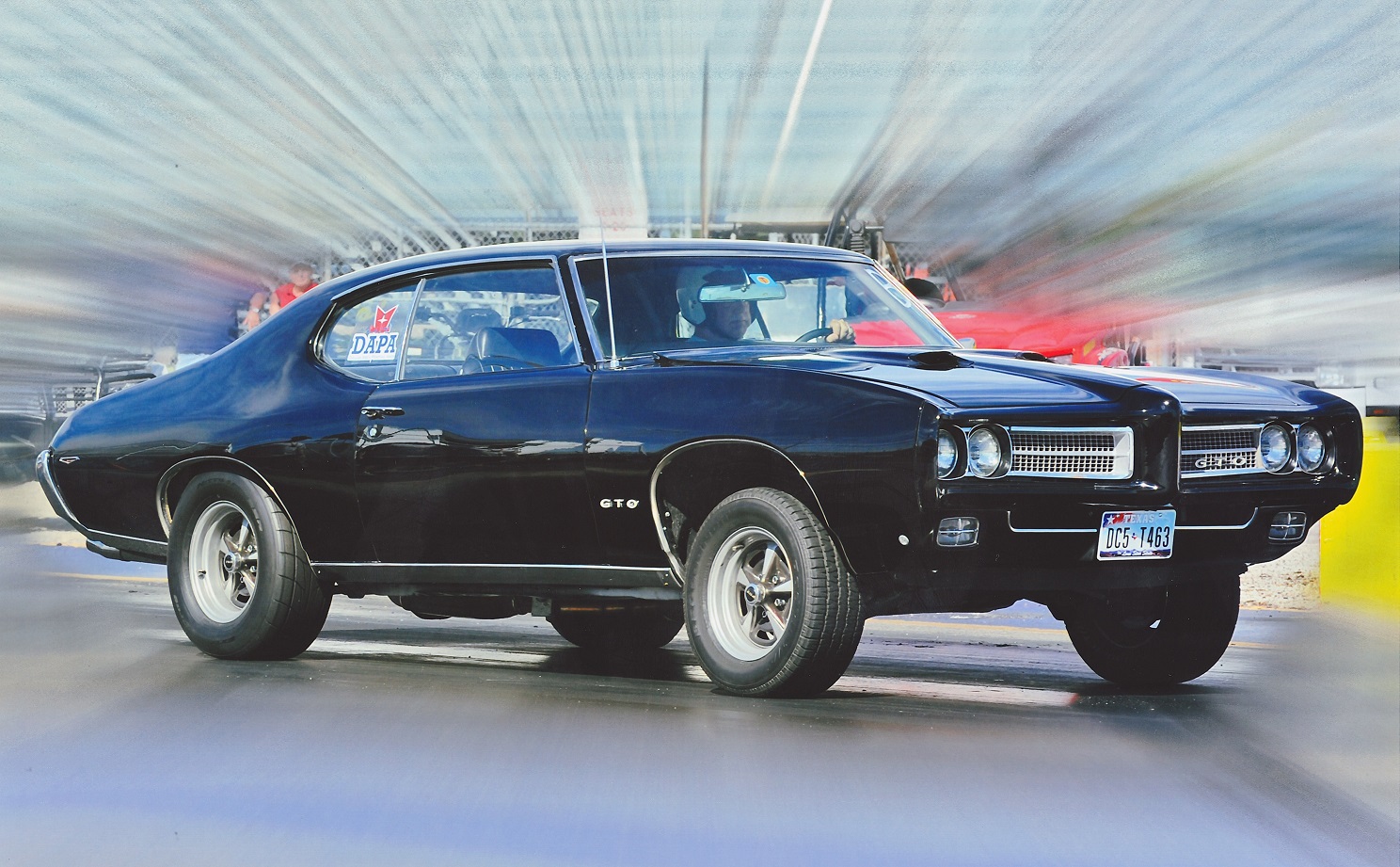
Building a Strong Street Machine – Part 2: Engine Characteristics

“This engine doesn’t know if it is a Chevy, Ford, or a Pontiac!”

I have heard capable mechanics and engine builders say those words many times. Of course an engine doesn’t know anything. However, anyone that thinks that all engines will respond to changes similarly simply have not done their homework on engine operation. Such variables as head design, displacement, compression, and bore/stroke ratio have a significant effect on an engine’s performance characteristics.

A perfect example of such a variable is the Pontiac V8 camshaft design. The Factory Engineers found that a dual pattern cam with about 10 additional degrees duration on the exhaust performed best in Pontiac engines. (All Pontiac V8 cams with the exception of the late ’50’s – early ’60’s low compression economy pattern). However, the Chevy small block engine works well with a single pattern cam. Since the majority of cams sold by aftermarket vendors are for the Chevy, the Vendors design a cam for that engine and transfer the grind to other makes of cams. Wow, a new magic cam for our Pontiacs! No matter that it doesn’t have the extra exhaust duration that the Pontiac needs and that it won’t work worth a damn. Many buyers believe that some hole-in-the wall cam maker can make a cam work better that the Pontiac Engineers who designed nothing but Pontiacs and who probably had more hours of testing Pontiac engines than all the cam makers combined. Note: Some of the cam makers sell cams for Pontiacs that are identical to Pontiac grinds and those should work fine. Also, they advertise grinds very similar to stock cams and these should perform about like stock units. It should be noted that others report that a 455 seems to work OK with a single pattern cam due to the very high piston velocity. However, I recommend a dual pattern on all Pontiacs.

Obviously, compression ratios or displacement variations will make an engine act differently.

The bore/stroke ratio will affect the operational RPM range of an engine. If the bore is large in comparison to the stroke (oversquare), the engine will generally produce it’s maximum HP and torque at a higher RPM. Conversely, if the stroke is greater than the bore (undersquare), the power range occurs at lower RPM’s. Also, a long stroke engine of comparable displacement to a short stroke engine will produce greater torque and the torque peak will occur at lower RPM. The 455 Pontiac is a classic example of a torque engine. With a bore of 4.15 ” and a stroke of 4.21″, it is one of the highest (if not the highest) torque producing engines that has been built. However, because of long stroke, the upper RPM range is limited both functionally and physically. The combination of the long stroke and the Pontiac head design causes the power range to fall off fairly sharply at the higher RPM. The long stroke cause the rod and piston to travel at higher speeds in comparison to a short stroke engine and the RPM must be limited to prevent physical damage to the engine.

Why have we discussed the preceding information? Almost all the “hop up” information published over the years has been oriented to small block engines and more specifically to small block Chevy’s. (Some of the older readers may remember the flat head Fords but they responded much like the small Chevy’s.) I wanted to remind you that most of what you have heard or read does not apply to Pontiac engines. The best approach in improving Pontiac performance is to review and understand what Pontiac Engineering did during those wonderful years between 1956 and 1970.

Pontiac literally built the fastest and quickest production cars during that entire period. Yes, there some special low production cars/engines from the other makers that were very strong – the MOPAR hemis, special Corvettes, Ford Cobras, etc., but model for model, the Pontiacs were very hard to beat. You must understand that if trick aftermarket parts would have helped, Pontiac Engineering would have incorporated them in the production. In fact, Pontiac was ahead of the aftermarket vendors in designing better exhaust systems, stronger cams, the Q Jet carb, and the excellent intake manifold of ‘67 to ‘73 period. However, almost all “performance parts” now available in the aftermarket will cause either a loss of horsepower or torque at some point in the RPM range with a resulting loss in overall performance. The only hop-up tricks that work without some penalty are; increasing displacement, increasing compression within certain limits, improving the exhaust system, and of course, a good tune-up of the carb and distributor.

We must also understand how Pontiac applied their engines. They never installed a RAM AIR IV in a 4400 pound Bonneville because it simply would not have performed as well as a milder engine designed for that car, and they never released a High Performance engine in a vehicle with a high axle ratio such as a 2.41. Why? For best all around performance, the engine parameters, vehicle weight, axle ratio, transmission type, and the planned use must be considered.

In upcoming issues, we will look in detail at the Pontiac design philosophy and will discuss how we can improve performance. We define performance as drivability, increased power in the driving ranges, reasonable gas mileage, sensible RPM ranges and reliability.

Technical Articles that equal Pontiac Performance

DAPA has decided to rerun two series of articles written by Jim Hand. These articles can give you a quick education on both, increasing the performance of your Pontiac, and understanding how to apply that performance at the track.

The titles of each of the series speak for themselves:

  • Building a Strong Street Machine

  • Drag Racing With Jim Hand

Click on each of the titles and get educated!

Building a Strong Street Machine – Part 1: Introduction

This series was prepared over a 2-3 year period for our local Clubs.

As we obtained newer or more accurate information, it was incorporated in later articles. Accordingly, if you note any conflict of information in this series, use the latest. This is a collection of information that the writer and his advisors have accumulated over the years in actual Pontiac tuning, modifying, and racing. We won’t tell you how to build race cars but we will describe how you can make your street car perform better than many “race cars”. We will discuss how basic components like camshafts, intake manifolds, and exhaust systems interact and what happens when you change them.

The local newspaper, Kansas City Star, ran the results of a bracket race, and one of the local club members, Verne Howard, won the trophy class with his ‘77 Can Am with times of 14.901/90.9 on a 14.90 dial.

A few comments about Verne’s car are in order. At first glance, 14.90 at 91 MPH might not sound very impressive. However, Verne’s ‘77 CAM AM with driver weighs 4300 – 4400 pounds, and his 400 engine is low compression, has the less effective low rise intake manifold, and is essentially stock. The car has a 3.08 gear ratio. The same engine in a 64/65 A body car weighing 3700 – 3800 pounds would propel it to approximately 14.40 at 96/97 MPH. Why does it run so well? Verne did a series of practical and low cost checks and modifications. He first made sure the engine was in good mechanical condition. As the original cam was worn and a stock replacement was not available, he installed a Pontiac grind (067 – the original cam for stock GTOs and 2+2s) that was closest to his original. The carb and distributor were checked and rebuilt and a slightly modified advance curve was installed in the distributor. A dual exhaust system consisting of RAM-AIR exhaust manifolds, Walker Super Dynomax mufflers, and 2 1/4″ pipes was installed. For the race, a pair of good traction street tires was installed. One evening of practice and tuning and Verne is now a trophy winner.

In our upcoming features, we will explain why simple changes like Verne made are so effective and why most after market speed parts generally don’t work very well on street Pontiacs. Again, we will not attempt to describe Pontiac race engine construction but will focus on how to get great performance from your street cars at the lowest cost.

Return top

DAPA cars are the stars!

Loading...


Loading...

Login


Register | Lost password?

Register


A password will be mailed to you.
Log in | Lost password?

Retrieve password


A confirmation mail will be sent to your e-mail address.
Log in | Register